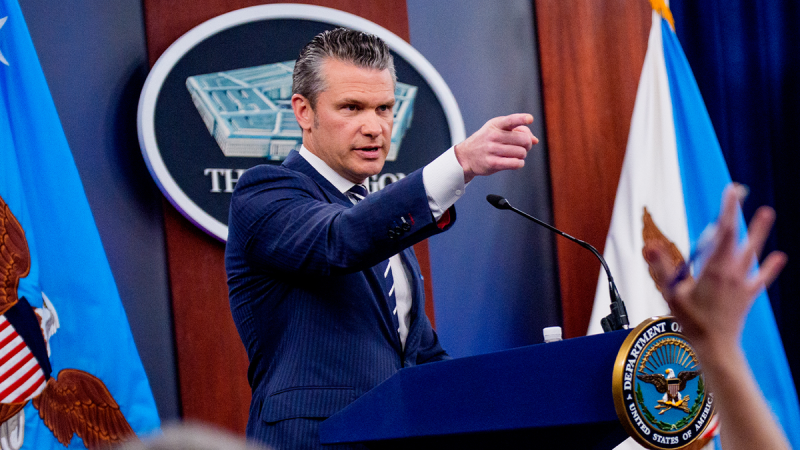
War Secretary Pete Hegseth said Wednesday that Iran’s decision to strike neighboring countries has backfired strategically, driving Gulf states that had hoped to stay out of the conflict ‘into the American orbit’ as the U.S. prepares to dramatically increase firepower over Tehran.
‘What Iran is doing by targeting allied countries that would otherwise want to stay out of this, they’ve actually pulled them into the American orbit,’ Hegseth said during a briefing at U.S. Central Command headquarters in Tampa, Florida.
He cited the United Arab Emirates, Qatar, Bahrain, Saudi Arabia and Kuwait as countries now offering expanded cooperation, arguing that Tehran’s retaliatory campaign has strengthened regional alignment with Washington rather than weakened it.
U.S. military officials say Iran has launched strikes against a growing number of countries in the region since the conflict began, with CENTCOM Commander Adm. Brad Cooper noting Tehran has targeted at least a dozen nations.
Rather than isolating the United States, Hegseth suggested Iran’s actions are consolidating support for the campaign.
‘The amount of firepower over Iran and over Tehran is about to surge dramatically,’ he said, pointing to additional base access and increased bomber operations.
Hegseth also addressed allied base access, including the United Kingdom’s initial hesitation to grant U.S. forces early access to strategic facilities. He said the issue has since been resolved and that British-controlled bases are now part of the expanding U.S. air campaign.
‘It was unfortunate that … the Brits didn’t, from day one say, ‘Hey, go ahead and have access,’’ he said. ‘But we got there, we got there. And that’s now part of the way that we’re operationalizing bomber runs. … The amount of firepower over Iran and over Tehran is about to surge dramatically, and part of it is that we’re going to have even more basing.’
Gulf and Arab governments have publicly condemned Iranian missile and drone strikes on their territories as violations of sovereignty and threats to regional security, while stopping short of criticizing U.S. military action.
Saudi Arabia, Qatar, Bahrain, Kuwait, the United Arab Emirates and Jordan issued a joint statement strongly condemning Iran’s ‘indiscriminate and reckless’ missile and drone attacks against sovereign territory in the region, reaffirming their right to self-defense.
Regional leaders have framed Iran’s actions as dangerous escalations rather than legitimate retaliation, underscoring a rare moment of unified public opposition among Gulf Cooperation Council members.
Beyond the Gulf, Azerbaijan has also protested what it says were Iranian drone strikes on its Nakhchivan exclave, which injured civilians and damaged the international airport. Baku summoned Tehran’s ambassador and said it reserved the right to take retaliatory measures in defense of its territory, even as Tehran denied responsibility for the incident.
Some regional analysts say Iran appears to have miscalculated by striking at U.S. assets in third-party nations.
‘It was absolutely inevitable that the Iranians would seek to lash out, to widen the conflict … but all they’ve really done is made everybody quite mad, and that was a really bad calculation on their part,’ said Danielle Pletka, a senior fellow at the American Enterprise Institute.
Peter Doran, a senior fellow at the Foundation for Defense of Democracies, noted the shift in regional alignment.
‘It would have been unbelievable just one year ago to see Saudi Arabia and the Gulf states lining up with the United States and Israel against the Islamic Republic,’ he said.
Hegseth dismissed suggestions that the war is spiraling outward, arguing that Iran’s actions are instead clarifying the battlefield and strengthening U.S. partnerships.
‘This idea that it’s expanding or going — no,’ he said. ‘It’s actually simplifying in a number of ways exactly what we need to achieve and how we’ll achieve it.’
Pentagon officials say U.S. bombers have struck nearly 200 targets in the past 72 hours, destroyed more than 30 Iranian naval vessels and significantly reduced missile and drone attacks since the opening days of the operation.
Officials maintain that the campaign’s objectives remain limited to degrading Iran’s ability to threaten Americans and its neighbors, even as the president has suggested he needs to have a say in who becomes Iran’s next leader.
‘I think the president’s having a heck of a say in who runs Iran, given the ongoing operation we have,’ Hegseth said.